
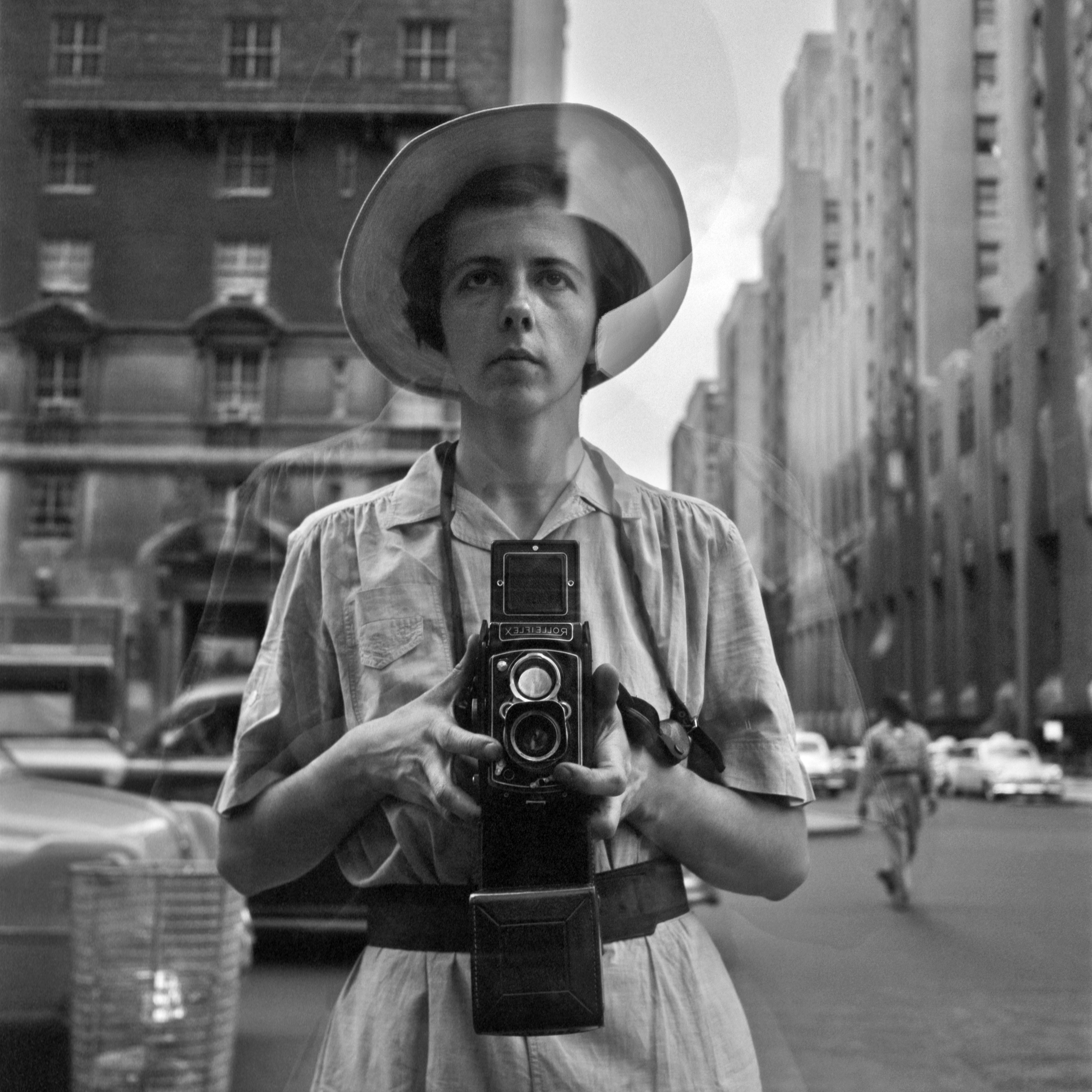
The progress of art history is not always linear. Some works of art or their creators, which have long been hidden in the shadows, are sometimes rediscovered only when we return to the past along the already trodden path. Such a phenomenon is perfectly illustrated by the fate of Vivian Maier. Although unknown during her lifetime, she is today considered one of the most important photographers of the 20. for centuries, we put it side by side with famous names such as Diane Arbus, Henri Cartier Bresson and Robert Frank. Vivian Maier lived aloof and modestly as a governess far from artistic circles. It was only after the relatively late discovery of the archive that the general public realized the full scope and importance of her work.
Vivian Maier was born in 1926 to a French mother and a father of Austro-Hungarian roots. Her youth was marked by family tensions and great volatility. She spent part of her childhood torn between NE Animatork and the Champsaur Valley in the French Alps.
In the Fifties, she finally settled in the United States: at first she lived in NE Animatork, and later in Chicago, where she worked as a governess for various families for almost four decades. This profession allowed her to observe society hushed up, from the periphery. In her free time, with a camera in hand, she tirelessly wandered the streets of the city, photographing scenes from everyday life. Her photographic oeuvre is very extensive: it covers almost one hundred and fifty thousand photographic images and hundreds of films shot on super 8-and 16-mm
format.
The central scene of Vivian Maier's creation was the street. She was especially interested in working – class quarters and local – nameless for her-residents. She sought to reveal what usually goes unnoticed: the seemingly secondary moments from which social reality is really woven.
Portraits also occupy an important place in Vivian Maier's opus. She loved to photograph the outcast: poor workers, homeless people, outcasts and loners, who are usually overlooked in the social space. She portrayed them with dignity and realism, always without staging and special effects. That is why her photographs reveal the contradictions and tensions of the then American Society, which lurk for the ubiquitous image of the "American dream". Here and there, she also aimed her lens at the wealthier social strata, as evidenced by witty photographs of some representatives of high society.
Another key aspect of her oeuvre is the frequent presence of the self-portrait. Vivian Maier often appears in her photographs, but only indirectly: sometimes as a shadow on the floor or as a reflection in a shop window, and other times her image is fragmentary. With such procedures, she imprinted her presence in the photo without losing her distance from the depicted. With a self-portrait, she confirmed her existence in a world that pushed her into the background for the sake of her social position.
These images reflect the search for identity and the desire to leave a trace in this world and imprint on it the mark of its existence in it. Over the years, her work has evolved and opened up new forms ofexperimentation. At the end of the Fifties, she began to photograph in color with a Leica brand camera. These became the central building block of her composition: from colors she created visual rhythms similar to musical forms. In that period, she also became interested in moving images: at that time she shot many films with 16 - and 8-mm cameras.
Although her oeuvre was extremely extensive, she never wanted to present it to the public. Most of these photographs remained unpublished during her lifetime. This rich archive was discovered only after her death in 2009 and only then gradually revealed to the public. But it was this late discovery that probably contributed to a renewed understanding and appreciation of her work, which is now considered one of the richest and most subtle depictions of urban life in the 20s. century.
Anne Morin, exhibition curator
The Life of Vivian Maier (1926-2009) is the story of a long-overlooked photographer who, by carefully observing the everyday life of the city and casual passers-by, created a monumental document of her time, revealing at the same time a deep humanity. Far from the spotlight, she created an extraordinary photographic oeuvre, which became known only after her death, and today she is one of the most important photographers of the 20. for centuries, we put it side by side with famous names such as Diane Arbus, Henri Cartier-Bresson and Robert Frank.
The story of her unusual discovery and life is also told by the documentary in search of Vivian Maier (Finding Vivian Maier), which, among other things, also received an Oscar nomination for Best Documentary film.
Napredek umetnostne zgodovine ni vselej linearen. Nekatera umetniška dela oziroma njihove ustvarjalce, ki so se dolgo skrivali v senci, včasih znova odkrijemo šele tedaj, ko se po že uhojeni poti vrnemo v preteklost. Takšen fenomen odlično ponazarja usoda Vivian Maier. Čeprav je bila v svojem življenju neznana, jo danes kot eno najpomembnejših fotografinj 20. stoletja postavljamo ob bok slavnim imenom, kot so Diane Arbus, Henri Cartier Bresson in Robert Frank. Vivian Maier je živela odmaknjeno in skromno kot guvernanta daleč od umetniških krogov. Šele po razmeroma poznem odkritjunjenega arhiva je širša javnost spoznala celoten obseg in pomen njenega dela.
Vivian Maier je bila rojena leta 1926 v New Yorku materi Francozinji in očetu avstro-ogrskih korenin. Njeno mladost so zaznamovale družinske napetosti in velika nestanovitnost. Del otroštva je preživela razpeta med New Yorkom in dolino Champsaur v francoskih Alpah.
V petdesetih letih se je dokončno ustalila v Združenih državah Amerike: sprva je živela v New Yorku, pozneje pa v Chicagu, kjer je skoraj štiri desetletja delala kot guvernanta pri različnih družinah. Ta poklic ji je omogočal, da je družbo opazovala pritajeno, z obrobja. V prostem času je s fotoaparatom v roki neutrudno pohajkovala po mestnih ulicah in fotografirala prizore iz vsakdanjega življenja. Njen fotografski opus je zelo obsežen: zajema namreč skoraj sto petdeset tisoč fotografskih podob in več sto filmov, posnetih na super 8- in 16-milimetrski
format.
Osrednje prizorišče ustvarjanja Vivian Maier je bila ulica. Zanimale so jo zlasti delavske četrti in tamkajšnji – zanjo brezimni – prebivalci. Prizadevala si je razkriti tisto, kar običajno ostane neopaženo: dozdevno postranske trenutke, iz katerih je v resnici stkana družbena resničnost.
Pomembno mesto v opusu Vivian Maier imajo tudi portreti. Rada je fotografirala obstrance: revne delavce, brezdomce, izobčence in samotarje, ki jih v družbenem prostoru navadno spregledamo. Upodabljala jih je dostojanstveno in stvarno, vselej brez inscenacij in posebnih učinkov. Prav zato njene fotografije razodevajo protislovja in napetosti tedanje ameriške družbe, ki prežijo za vseprisotno podobo »ameriškega sna«. Tu in tam je svoj objektiv uperila tudi v premožnejše družbene sloje, o čemer pričajo duhovite fotografije nekaterih predstavnikov visoke družbe.
Še en ključen vidik njenega opusa je pogosta navzočnost avtoportreta. Vivian Maier se namreč nemalokrat tudi sama pojavlja na svojih fotografijah, a le posredno: včasih kot senca na tleh ali kot odsev v izložbenem oknu, spet drugič pa je njena podoba fragmentarna. S takšnimi postopki je svojo prezenco vtisnila v fotografijo, ne da bi izgubila distanco do upodobljenega. Z avtoportretom je potrdila svoj obstoj v svetu, ki jo je zavoljo njenega družbenega položaja potiskal v ozadje.
Te podobe odslikavajo iskanje identitete in željo, da bi na tem svetu pustila sled in mu vtisnila pečat svojega bivanja v njem. Z leti se je njeno delo razvijalo in odpiralo novim oblikameksperimentiranja. Konec petdesetih let je začela s fotoaparatom znamke Leica fotografirati v barvah. Te so postale osrednji gradnik njene kompozicije: iz barv je ustvarjala vizualne ritme, podobne glasbenim oblikam. V tistem obdobju so jo začele zanimati tudi gibljive slike: takrat je s 16- in 8-milimetrsko kamero posnela številne filme.
Čeprav je bil njen opus izjemno obsežen, ga ni nikoli želela predstaviti javnosti. Večina teh fotografij je ostala v njenem življenju neobjavljena. Ta bogati arhiv so odkrili šele po njeni smrti leta 2009 in ga šele nato postopoma razkrili javnosti. A bržkone je prav to pozno odkritje pripomoglo k prenovljenemu razumevanju in vrednotenju njenega dela, ki danes velja za eno najbogatejših in najbolj pretanjenih upodobitev urbanega življenja v 20. stoletju.
Anne Morin, kuratorka razstave
Življenje Vivian Maier (1926–2009) je zgodba o dolgo spregledani fotografinji, ki je s pozornim opazovanjem mestnega vsakdanjika in naključnih mimoidočih ustvarila monumentalen dokument svojega časa, ki obenem razkriva globoko človečnost. Daleč od žarometov je ustvarila izjemen fotografski opus, ki je postal znan šele po njeni smrti, danes pa jo kot eno najpomembnejših fotografinj 20. stoletja postavljamo ob bok slavnim imenom, kot so Diane Arbus, Henri Cartier-Bresson in Robert Frank.
Zgodbo o njenem nenavadnem odkritju in življenju pripoveduje tudi dokumentarni film V iskanju Vivian Maier (Finding Vivian Maier), ki je med drugim prejel tudi nominacijo za oskarja za najboljši dokumentarni film.