
You're on the site with all events in Slovenia, welcome!

You're on the site with all events in Slovenia, welcome!

DAYS OF REJECTION DNEVI ZAVRŽENOSTI

theatre
1%

Elena Ferrante
DAYS OF REJECTION
Koper Theatre
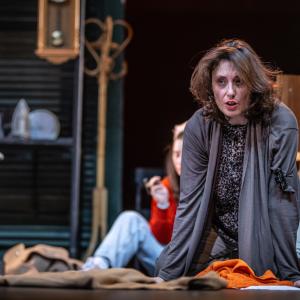
When, on an April afternoon, while washing dishes, Mario quickly tells his wife that he has been engulfed in an "emptiness of meaning" and that he is therefore leaving her after fifteen years of marriage, thirty-eight-year-old Olga, a mother of two who has encased the meaning of her life in the rites of marriage, instantly collapses the world. The initial bewilderment grows into a sobbing vindictiveness, the feeling of abandonment and loneliness forces her to commit unreasonable acts, and with increasing depression and self-restraint, together with the children and the dog, she becomes a prisoner of her own apartment and her own thoughts. In the worst period of being lost, she accumulates unpaid bills, buys unwashed laundry, neglects even her exterior, completely loses her maternal sense and becomes more and more absent. Only when she reaches the bottom in her free fall and accidentally poisons the family dog, which represented her last bond with Mario, she realizes that she no longer loves her husband, that for her it is less than history, just a stain on the past. Liberated and determined to return to writing, which she gave up at the very request of her husband, she now steps stronger towards a new life (and a partner) towards her.
The production of days of rejection is based on a novel of the same title by an Italian writer nicknamed Elena Ferrante, who, despite the success of her works (the most famous of which is her so-called Neapolitan tetralogy), remains a complete stranger. In her second novel from 2002, in a first-person narrative about a woman abandoned by her husband, she questions the identity of a modern, educated woman, marked by her gender, social role and motherhood, describes her mental hardships and struggles, as well as the reaction of society, friends and acquaintances to the situation of a just separated and helpless woman. The novel, which flirts with the ancient myth of Medea, and based on which the Italian director Roberto Faenza made a film in 2005, was adapted for the production at the Koper Theater by the dramatic actress and playwright Urska Taufer, and the production will be directed by Tijana Zinaji/.
* * *
Urska Taufer, co-author of dramatisation, about the text:
"You don't know what the void of meaning is," he says as he floats to the other side. "Maybe you just looked into the abyss, you got dizzy and quickly filled the hole with the body of a younger woman.«
Why this story? Why watch a play about a woman left by her husband? Only with two children. Why watch a play about a woman who collapses at the same time? Although she is intelligent, strong, independent.
Why would you want to observe her fall, her imminent annihilation in the void of meaning, the phrase with which the husband justifies his departure?
So why this story?
Because I experienced it. Because this is an intimate experience of almost every woman I know. Highway of feelings, emotions. A breakneck ride, with your foot on the gas, no hands on the steering wheel. Lonely wandering through a terribly large dark universe. Slippery, unfamiliar terrain that chaotically carries you away from all expectations, plans, from everything familiar, domestic, without airbags that have been forcibly cut out, without protection; it carries you away with lightning speed, from all your efforts, investments, you are looking for help, a companion, no one is there. During this ride, you try to take care of the milk on the stove, take the dog for a walk, the children to the doctor, understand what you did wrong, he carries you, takes you, the world is spinning immensely fast, beyond the point of controllability.
So why this story?
Because it stops once.
That's when you see yourself, face to face. Into myself. And you say to yourself, Oh, look at her! Long time no see you!
--

Elena Ferrante
DNEVI ZAVRŽENOSTI
Gledališče Koper
Ko Mario nekega aprilskega popoldneva med pomivanjem posode svoji ženi kar tako na hitro pove, da ga je zajela »praznina smisla« in da jo zato po petnajstih letih zakona zapušča, se osemintridesetletni Olgi, materi dveh otrok, ki je smisel svojega življenja zajezila v obrede zakonske zveze, v trenutku podre svet. Začetna osuplost preraste v ihtavo maščevalnost, občutek zapuščenosti in osamljenosti jo sili v nerazumna dejanja, z naraščajočo depresijo in samozavrženostjo pa skupaj z otrokoma in psom postane ujetnica lastnega stanovanja in lastnih misli. V najhujšem obdobju izgubljenosti se ji kopičijo neplačane položnice, kupi neopranega perila, zanemari celo svojo zunanjost, povsem izgubi materinski čut in postaja vse bolj odsotna. Šele takrat, ko v svojem prostem padu doseže dno in po nesreči zastrupi družinskega psa, ki ji je predstavljal še zadnjo vez z Mariom, spozna, da moža ne ljubi več, da je ta zanjo manj kot zgodovina, le madež na preteklosti. Osvobojena in odločena, da se bo vrnila k pisateljevanju, ki se mu je odrekla prav na moževo željo, zdaj močnejša stopi proti novemu življenju (in partnerju) naproti.
Uprizoritev Dnevi zavrženosti nastaja po romanu z enakim naslovom italijanske pisateljice z vzdevkom Elena Ferrante, ki kljub uspehu svojih del (najbolj znana je njena t. i. Neapeljska tetralogija ), ostaja popolna neznanka. V svojem drugem romanu iz leta 2002 v prvoosebni pripovedi o ženski, ki jo zapusti mož, preizprašuje identiteto sodobne, izobražene ženske, zaznamovane s svojim spolom, družbeno vlogo in materinstvom, opisuje njene duševne stiske in boje, hkrati pa tudi odziv družbe, prijateljev in znancev na položaj pravkar ločene in nemočne ženske. Roman, ki se spogleduje z antičnim mitom o Medeji, in po katerem je italijanski režiser Roberto Faenza leta 2005 posnel film, je za uprizoritev v Gledališču Koper priredila dramska igralka in dramatičarka Urška Taufer, uprizoritev pa bo režirala Tijana Zinajić.
* * *
Urška Taufer, soavtorica dramatizacije, o besedilu:
»Ne veš, kaj je praznina smisla,« mu reče, ko izplava na drugo stran. »Ti si mogoče le pogledal v prepad, zvrtelo se ti je in si luknjo hitro zapolnil s telesom mlajše ženske.«
Zakaj ta zgodba? Zakaj bi gledali predstavo o ženski, ki jo pusti mož? Samo z dvema otrokoma. Zakaj bi gledali predstavo o ženski, ki se ob tem sesuje? Čeprav je inteligentna, močna, samostojna.
Zakaj bi želeli opazovati njen padec, njeno skorajšnje izničenje v praznini smisla, besedni zvezi, s katero mož opravičuje svoj odhod?
Zakaj torej ta zgodba?
Ker sem jo doživela. Ker je to intimno doživetje skoraj vseh žensk, ki jih poznam. Avtocesta občutkov, čustev. Vratolomna vožnja, z nogo na plinu, brez rok na volanu. Osamljeno tavanje po strašno velikem temnem vesolju. Spolzek, neznan teren, ki te kaotično nese proč od vseh pričakovanj, načrtovanj, od vsega poznanega, domačega, brez airbagov, ki so bili na silo izrezani, brez zaščite; s svetlobno hitrostjo te nosi proč, od vseh tvojih naprezanj, investicij, iščeš pomoč, sopotnika, nikogar ni. Med to vožnjo poskušaš poskrbeti za mleko na štedilniku, pelješ psa na sprehod, otroke k zdravniku, razumeti, kaj si naredila narobe, nosi te, pelje te, svet se vrti neznansko hitro, čez točko obvladljivega.
Zakaj torej ta zgodba?
Ker se enkrat ustavi.
Takrat se zagledaš, iz oči v oči. V sebe. In si rečeš, o, glej jo! Dolgo te nisem videla!
--

Description and event details are taken from here. All copyrights belong to the respective authors.
Organiser:
PREŠERNOVO GLEDALIŠČE KRANJ
Address:
Glavni trg 6, 4000 Kranj
Phone:
04 / 280 49 00
Email:
pgk@pgk.si
Location: Dvorana PGK, Kranj