
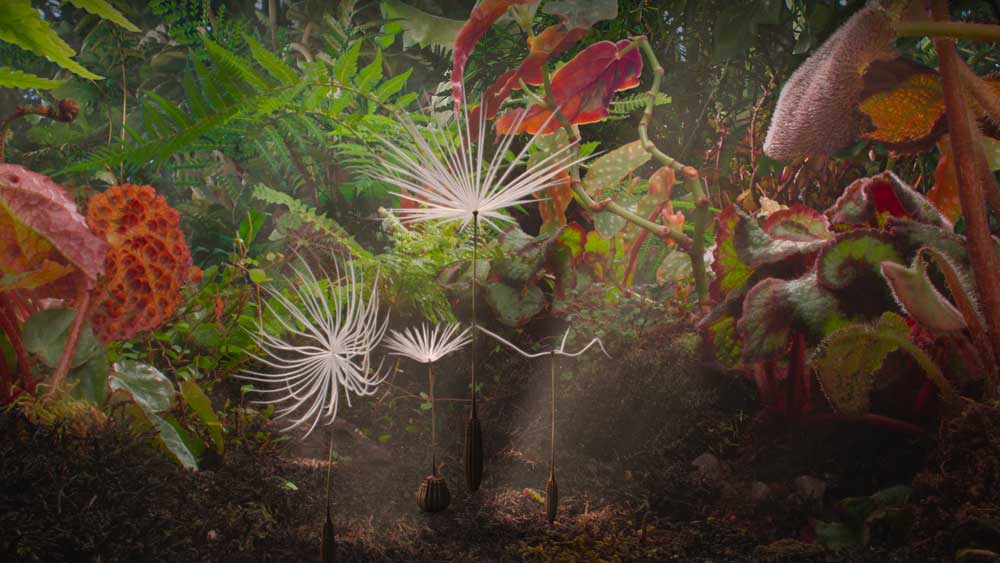
Four dandelion seeds are looking for a new home under the sky.
Story
After a nuclear accident, four dandelion seeds fly into the sky from Earth, looking for a new home. They find themselves on a planet that is unusually beautiful, and sometimes scary. They are transported on snail lazars, flee from voracious tadpoles, admire the dance of fireflies under the stars and watch the growth of fungi. They travel across icy landscapes, rivers and seas, through forests and across deserts, looking for soil in which to sprout roots.
Festivals, awards
Annec 2025, Cannes FF 2025, Festival Europaculeen du Film Fantasti Modulue de Strasbourg 2025, Ping Modulao IFF 2025, Toronto IFF 2025, Festival de Noveau Cin Islamma Montreal 2025
About the author
Momoko Seto was born in Tokyo in 1980. She studied in Tokyo and Marseille, while also working as a director at the CNRS (National Centre of Scientific Research) in Paris. He creates experimental films in which he combines different genres. He makes short films and documentaries. She presented them at many festivals and received several awards for them. He lives and works in Paris.
Firsthand
"I used several different techniques for each image in the planet film series, from Interval shots, hyper-slow motion shots, ultramacro photography, and the StackShot tool to compose shots to achieve extended depth of field, all the way to robotics. Time-lapse recordings are the art of densifying time. With them, very slow natural phenomena are recorded over a long period of time, which are often invisible to the eye. When we spin the shots faster, we" finally " see the invisible. Hyper-slow motion is the art of opening up time. As with interval shots, the (Phantom) camera records a very fast movement and parses it. The recorded subject thus becomes "something else". Here, the technique is not just a tool for emphasizing what is seen, it reveals what lies beyond the visible world.«
- Momoko Seto
About making a movie
"This is not a documentary about plants, but science fiction," said the Japanese-French director, highlighting the role of sound and music in the film, which is devoid of dialogue. During the creation, they wondered, among other things, how the snail sounds when it crawls out of the ground, and what is the sound of dandelion lights or beech oyster mushrooms during growth, for which they used the sounding of whales.
Criticism
"The feature film journey of the dandelion lantern by Japanese artist Momoko Seto eludes a clear genre classification. It is a hybrid of computer animation, macrophotography and recordings at intervals , the so-called timelaps, which weave a gentle narrative about the world after the end of the world in the absence of dialogues. But although parallels with the animation Ripple are quickly established on paper , Momoko Seto takes us one step further with his debut: into the life of plants, the four seeds of the dandelion light, which he launches into space after the nuclear destruction of the Earth.«
Veronika Zakonjsek, Diary
"The undergrowth of ferns becomes an extremely dense jungle, mushrooms climb into the sky like huge, thousand-year-old trees, the praying mantis becomes a frightening and dangerous monster, and the wandering Lazarus become peaceful, loving creatures that the lanterns can use as a means of transportation when the desperate and exhausted are barely standing upright. Momoko Seto puts nature at the forefront, which in films is most often just a backdrop and a motionless background, in front of which (both literally and figuratively) people or animals are placed. In fact, her whole world is made up of elements of nature, thereby Momoko Seto directly shows her key role and importance. Dandelion lights are just one piece of the puzzle, and the journey is a film that finds a lot in the tiny – the lights are forced to migrate due to the destruction caused by man, and by focusing on nature, Momoko Seto shows the essential thing: nature does not need Man, because the cycle of life will be able to continue even without us.«
- Tinkara Ursic Fratina, Corridor
Štiri regratove semenke iščejo nov dom pod nebom.
Zgodba
Po jedrski nesreči z Zemlje v nebo odfrčijo štiri regratove semenke in iščejo nov dom. Znajdejo se na planetu, ki je nenavadno lep, včasih pa tudi strašljiv. Prevažajo se na polžih lazarjih, bežijo pred požrešnimi paglavci, občudujejo ples kresnic pod zvezdami in opazujejo rast gliv. Potujejo preko ledenih pokrajin, rek in morja, po gozdu in čez puščave ter iščejo zemljo, v kateri bi lahko pognale korenine.
Festivali, nagrade
Annecy 2025, Cannes FF 2025, Festival Européen du Film Fantastique de Strasbourg 2025, Pingyao IFF 2025, Toronto IFF 2025, Festival de Noveau Cinéma Montreal 2025
O avtorici
Momoko Seto se je rodila v Tokiu leta 1980. Študirala je v Tokiu in Marseillu, hkrati pa delala kot režiserka pri CNRS (National Centre of Scientific Research) v Parizu. Ustvarja eksperimentalne filme, v katerih kombinira različne žanre. Snema kratke filme in dokumentarce. Predstavila jih je na številnih festivalih in zanje prejela več nagrad. Živi in dela v Parizu.
Iz prve roke
»Za vsako podobo v seriji filmov o planetih sem uporabila več različnih tehnik, od posnetkov v časovnih presledkih, hiperpočasnih posnetkov, ultramakro fotografije in orodja StackShot za sestavljanje posnetkov za doseganje razširjene globinske ostrine pa vse do robotike. Posnetki v časovnih presledkih so umetnost zgoščanja časa. Z njimi v daljšem časovnem obdobju zabeležimo zelo počasne naravne pojave, ki so za oko pogosto nevidni. Ko posnetke zavrtimo hitreje, »končno« ugledamo nevidno. Hiperpočasni posnetki pa so umetnost razpiranja časa. Tako kot pri posnetkih v časovnih presledkih (fantomska) kamera zabeleži zelo hitro gibanje in ga razčleni. Posneti subjekt tako postane »nekaj drugega«. Tukaj tehnika ni samo orodje za poudarjanje videnega, temveč razkriva tisto, kar leži onkraj vidnega sveta.«
– Momoko Seto
O nastajanju filma
»To sicer ni dokumentarec o rastlinah, temveč znanstvena fantastika,« je povedala japonsko-francoska režiserka in poudarila vlogo zvoka in glasbe v filmu, ki je brez dialoga. Med ustvarjanjem so se med drugim spraševali, kako zveni polž, ko prileze iz zemlje, in kakšen je zvok regratovih lučk ali bukovega ostrigarja med rastjo, za kar so uporabili oglašanje kitov.
Kritike
»Celovečerni film Potovanje regratove lučke japonske umetnice Momoko Seto se izmika jasni žanrski klasifikaciji. Je hibrid računalniške animacije, makrofotografije in posnetkov v časovnih presledkih, tako imenovanega timelapsa , ki v odsotnosti dialogov tkejo nežno pripoved o svetu po koncu sveta. A čeprav se na papirju hitro vzpostavijo vzporednice z animacijo Valovanje , nas Momoko Seto s svojim prvencem ponese še korak dlje: v življenje rastlin, štirih semenk regratove lučke, ki jih po nuklearnem uničenju Zemlje izstreli v vesolje.«
– Veronika Zakonjšek, Dnevnik
»Podrastje praproti postane izredno gosta džungla, gobe se vzpenjajo v nebo kot ogromna, tisočletna drevesa, bogomolka postane zastrašujoča in nevarna pošast, gomazeči lazarji pa mirni, ljubeči stvori, ki jih lučke lahko izkoristijo kot prevozno sredstvo, ko obupane in izmučene komaj še stojijo pokonci. Momoko Seto v ospredje postavlja naravo, ki je v filmih sicer najpogosteje le kulisa in negibno ozadje, pred katerega so (tako dobesedno kot figurativno) postavljeni ljudje ali živali. Pravzaprav je ves njen svet sestavljen iz elementov narave, s čimer Momoko Seto neposredno pokaže njeno ključno vlogo in pomen. Regratove lučke so le en delček sestavljanke, Potovanje pa film, ki v drobnem najde veliko – lučke so prisiljene v migracijo zaradi uničenja, ki ga je povzročil človek, z osredotočanjem na naravo pa Momoko Seto pokaže tisto bistveno: narava človeka ne potrebuje, kajti cikel življenja se bo lahko nadaljeval tudi brez nas.«
– Tinkara Uršič Fratina, Koridor