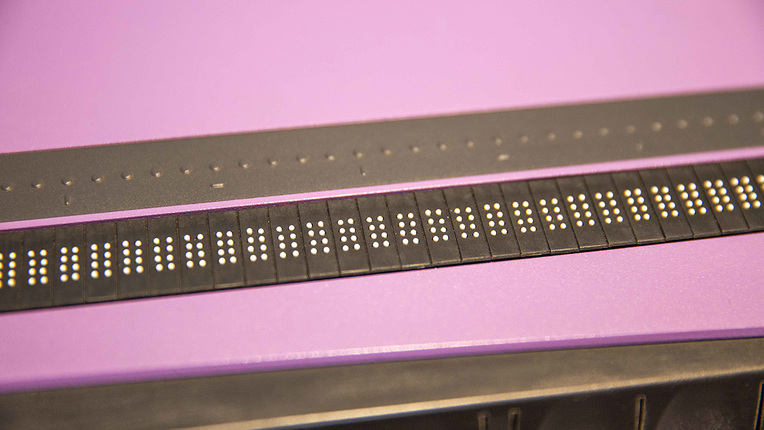
The tactile gallery also exhibits gadgets that have helped the blind and visually impaired in reading and writing over the past hundred years.
Reading and writing are the basis for learning, and although they seem self-evident, for many, including the blind and visually impaired, this was not always the case. Less than a year after the opening of the first tactile Gallery in Slovenia, the exhibition Art Beyond the visible in Kromberk is supplemented with a new visiting temporary exhibition entitled "literacy of the blind, using Braille and sound", which is part of the permanent museum exhibition in Ljubljana, set up in the library of the blind and visually impaired Minka Skaberne (KSS).
The library, like the commission for museum activities, operates within the Association of blind and visually impaired Societies of Slovenia (ZDSSS) and the association has lent us some exhibits from its rich collection.
Many inventions have brought about a major change in this field over the past two centuries as well. With the permanent museum exhibition" blind writing from point of view to E-reader", the KSS aims to show how the blind read and wrote over time, and how they gained knowledge and established themselves in various areas of social life.
From now on, it is also possible to learn about some devices, gadgets and tools in the tactile gallery that helped the blind and visually impaired in the past, some of which still play this role today.
In addition to works of Art, until May 2026, visitors can encounter a few basic gadgets, such as a braille tablet from the second half of the 20th century. century, on which it is written from right to left. Also on display is a stylus for writing on a braille tablet, which the user Ivan got along with the tablet in the institution for the blind after the end of the 2. World War II, learned to write with her, and at a mature age until 2015, you took notes. Brava typewriters have been used by the blind since 1919 in the First Institute for the blind in Ljubljana. They are typed with six fingers, and the thumbs serve to press the space bar. Among the rare items on display is a 1948 book in Braille for learning the violin, which served music lessons until 2002. The two-track monocassetophone was used mainly by blind students and students to listen to the learning material, and the built-in microphone allowed them to make their own recordings. The exhibition also includes a reel-to-reel tape recorder, one of the first tape recorders in Slovenia after 2. World War II.
This unique space from the point of view of accessibility to vulnerable groups was designed by the Gorizia Museum and inter - municipal Society of the blind and visually impaired Nova Gorica with partners within the framework of the official programme of the European capital of Culture 2025-Gorizia and, with the financial support of the Ministry of culture of the Republic of Slovenia, enriches the cultural offer and raises awareness of the general public this year as well.
Tactile gallery schedule: Monday-Saturday: from 10.00 to 13.00 and 13.30 to 18.00 (Sundays and holidays closed)
Photo By Katarina Brezan
V taktilni galeriji so razstavljeni tudi pripomočki, ki so slepim in slabovidnim v zadnjih sto letih pomagali pri branju in pisanju.
Branje in pisanje sta osnova za učenje, in čeprav se zdita samoumevna, za mnoge, tudi za slepe in slabovidne, ni bilo vedno tako. Manj kot leto dni po odprtju prve taktilne galerije v Sloveniji razstavo Umetnost onkraj vidnega v Kromberku dopolnjujemo z novo gostujočo začasno razstavo, naslovljeno »PISMENOST SLEPIH, Z UPORABO BRAJICE IN ZVOKA«, ki je del stalne muzejske razstave v Ljubljani, postavljene v Knjižnici slepih in slabovidnih Minke Skaberne (KSS).
Knjižnica, tako kot Komisija za muzejsko dejavnost, delujeta v okviru Zveze društev slepih in slabovidnih Slovenije (ZDSSS) in prav zveza nam je posodila nekaj eksponatov iz svoje bogate zbirke.
Številni izumi so v zadnjih dveh stoletjih prinesli veliko spremembo tudi na tem področju. S stalno muzejsko razstavo »SLEPOPISJE OD TOČKOPISA DO E-BRALCA« v KSS želijo prikazati, kako so slepi skozi čas brali in pisali, ter kako so se s pridobljenim znanjem uveljavljali na različnih področjih družbenega življenja.
Odslej je mogoče tudi v taktilni galeriji spoznati nekatere naprave, pripomočke in orodja, ki so slepim in slabovidnim pomagali v preteklosti, nekateri pa imajo to vlogo še danes.
Poleg umetniških del se lahko obiskovalci do maja 2026 srečajo z nekaj osnovnimi pripomočki, kot so brajeva tablica iz druge polovice 20. stoletja, na katero se piše od desne proti levi. Razstavljena je tudi pisalka za pisanje na brajevo tablico, ki jo je uporabnik Ivan dobil skupaj s tablico v Zavodu za slepe po koncu 2. svetovne vojne, se z njo učil pisati, v zreli dobi do leta 2015 pa si delal zapiske. Brajeve pisalne stroje so slepi uporabljali že od leta 1919 v prvem Zavodu za slepe v Ljubljani. Nanje se tipka s šestimi prsti, palca pa služita za pritiskanje preslednice. Med razstavljenimi redkimi predmeti je knjiga v brajici za učenje violine iz leta 1948, ki je služila glasbenemu pouku vse do leta 2002. Dvosledni monokasetofon so uporabljali predvsem slepi študentje in dijaki za poslušanje učne snovi, vgrajen mikrofon pa jim je omogočal izdelavo lastnih posnetkov. Na razstavo je prav tako umeščen kolutni magnetofon, eden prvih magnetofonov na Slovenskem po 2. svetovni vojni.
Ta edinstveni prostor z vidika dostopnosti ranljivim skupinam sta v okviru uradnega programa Evropske prestolnice kulture 2025 Nova Gorica - Gorizia zasnovala Goriški muzej in Medobčinsko društvo slepih in slabovidnih Nova Gorica s partnerji ter ob finančni podpori Ministrstva RS za kulturo kot dediščina EPK bogati kulturno ponudbo in osvešča širšo javnost tudi v letošnjem letu.
Urnik taktilne galerije: ponedeljek–sobota: od 10.00 do 13.00 in 13.30 do 18.00 (nedelje in prazniki zaprto)
Foto: Katarina Brešan