
You're on the site with all events in Slovenia, welcome!

You're on the site with all events in Slovenia, welcome!

HEIDI HEIDI

theatre
26%

Directed By Ivana Djilas
Performance for children
Baptismal staging
The Swiss writer Johanna SP Modri (1827-1901) began writing quite late, when she turned forty, and until that time, as befits those times, she was engaged in raising her son. She wrote about life in the countryside, her books were mainly aimed at children in order to cheer them up with their stories. The classic novel of Youth literature Heidi was published in 1881 with a subtitle for children and those who love children . Most of her works are now forgotten, but Heidi's novel, despite being written at the end of the 19th century. for centuries, it remains today one of the most famous youth works of Swiss literature.
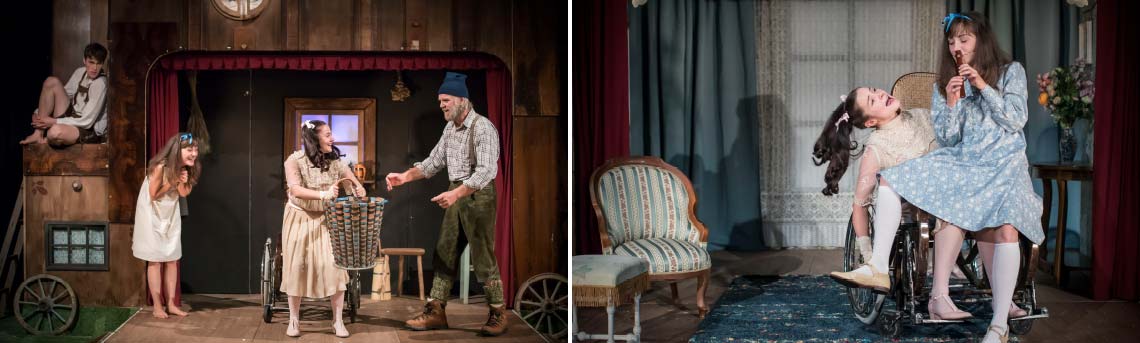
Heidi is an orphan and lives with her aunt Dete after the death of her parents. When her aunt is offered a well-paid job in the city, she takes Heidi to her grandfather's place on the mountain. With his reclusive lifestyle, the mysterious grandfather stirs the imagination of the villagers, but in reality he is also lonely and unhappy. He retired to life high in the mountains, where he lives connected to nature.
Grandfather and Heidi quickly become attached, finding in each other the family and love they longed for. Heidi falls in love with nature, where she completely frees herself. Her grandfather teaches her life with nature, encourages her in her explorations and educates her into an independent being. Heidi also meets her friend Peter on the mountain. One day aunt Dete returns unannounced and takes Heidi to town for socialite sick Klari.
Heidi does not like life in the city, because it is full of rules and restrictions, embodied by the nanny, miss Rottenmeier. Klara lives under the watchful eye of a nanny who is overprotective and does not allow her anything. Clara's father treats his daughter as if she is terminally ill, runs away to work, and tries to atone for his absence with gifts. It is the protective attitude that makes Clara an invalid. She lives in a world of very prohibitions that are supposed to protect her, but in fact harm her. Heidi is Clara's opposite, she is free-spirited, rebellious, inquisitive and persistent. It is with his rebellious and free-thinking spirit that he encourages Clara to start living.
Heidi is a story about freedom that can only be felt in nature, about the relaxation that man finds in connection with nature, about rebellion, perseverance and courage, which are the drivers of life's changes. It is a story about love and the power of love and testifies to the fact that a family is people who love each other, help each other and take care of each other, no matter how many members it consists of. It is a story about two different principles of upbringing, about upbringing that encourages the child to become an independent and responsible being, although the path to get there is sometimes painful, and upbringing that protects the child to the point of making him mentally and physically disabled.
A bestseller with over 80 repetitions!

Režiserka Ivana Djilas
Predstava za otroke
Krstna uprizoritev
Švicarska pisateljica Johanna Spyri (1827–1901) se je začela s pisanjem ukvarjati dokaj pozno, ko je dopolnila štirideset let, do takrat pa se je, kot se je spodobilo za tiste čase, ukvarjala z vzgojo sina. Pisala je o življenju na podeželju, njene knjige so bile namenjene predvsem otrokom, da bi jih s svojimi zgodbami razveselila. Klasični roman mladinske literature Heidi je izšel leta 1881 s podnaslovom Za otroke in tiste, ki imajo otroke radi . Večino njenih del je danes pozabljenih, roman Heidi pa, kljub temu da je bil napisan konec 19. stoletja, še danes ostaja eno najbolj poznanih mladinskih del švicarske literature.
Heidi je sirota in po smrti staršev živi s teto Dete. Ko se teti ponudi dobro plačana služba v mestu, odpelje Heidi k Dedu na Planino. Skrivnostni Ded s svojim samotarskim načinom življenja buri domišljijo vaščanov, v resnici pa je tudi on osamljen in nesrečen. Umaknil se je v življenje visoko v gorah, kjer živi povezan z naravo.
Ded in Heidi se hitro navežeta, drug v drugem najdeta družino in ljubezen, po kateri sta hrepenela. Heidi se zaljubi v naravo, kjer se popolnoma osvobodi. Ded jo uči življenja z naravo, jo pri njenih raziskovanjih spodbuja in vzgaja v samostojno bitje. Heidi na Planini spozna tudi prijatelja Petra. Nekega dne se nenapovedano vrne teta Dete in odpelje Heidi v mesto za družabnico bolni Klari.
Heidi življenje v mestu ni všeč, saj je polno pravil in omejitev, ki jih pooseblja varuška, gospodična Rottenmeier. Klara živi pod budnim očesom varuške, ki je preveč zaščitniška in ji ničesar ne dovoli. Klarin oče se do hčerke vede, kot da je na smrt bolna, beži v delo, za svojo odsotnost pa se poskuša odkupiti z darili. Prav zaščitniški odnos je tisto, kar iz Klare naredi invalidko. Živi v svetu samih prepovedi, ki naj bi jo obvarovale, v resnici pa ji škodujejo. Heidi je Klarino nasprotje, je svobodomiselna, uporniška, vedoželjna in vztrajna. Prav s svojim upornim in svobodomiselnim duhom spodbudi Klaro, da začne živeti.
Heidi je zgodba o svobodi, ki jo lahko občutimo le v naravi, o sproščenosti, ki jo človek najde v povezanosti z naravo, o uporništvu, vztrajnosti in pogumu, ki so gonilo življenjskih sprememb. Je zgodba o ljubezni in moči ljubezni in priča o tem, da so družina ljudje, ki se imajo radi, si pomagajo in skrbijo drug za drugega, ne glede na to, koliko članov jo sestavlja. Je zgodba o dveh različnih principih vzgoje, o vzgoji, ki otroka spodbuja, da postane samostojno in odgovorno bitje, čeprav je pot do tja včasih boleča, in vzgoji, ki otroka ščiti do te mere, da iz njega naredi psihičnega in fizičnega invalida.
Uspešnica z več kot 80 ponovitvami!

Description and event details are taken from here. All copyrights belong to the respective authors.
Organiser:
Slovensko ljudsko gledališče Celje
Address:
Gledališki trg 5, 3000 Celje
Phone:
+386 (0) 3 4264 200
Email:
tajnistvo@slg-ce.si
Location: Dom kulture Velenje