
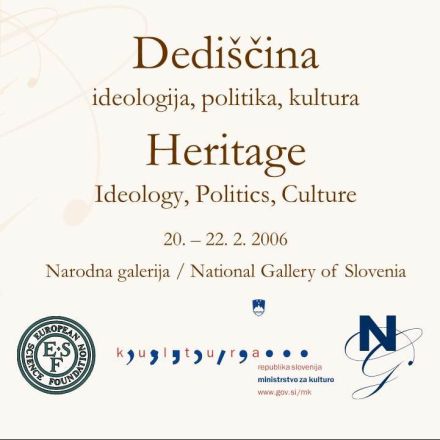
Abstract
This workshop is concerned with the meaning, practice and theory of heritage and cultural memory in relation to the preservation and reconstruction of architectural monuments, artworks and other visual artefacts.
Scientific Summary
The preservation and interpretation of artistic monuments was a central force behind the establishment of art history in numerous European countries. It played a key role in the development of national and cultural identities and still constitutes an important part of EU cultural strategy.
However, the idea of cultural heritage also has a range of distinct connotations that reflect the differences in the traditions and historical experiences of individual European nations during the past century. In Eastern Europe, in the aftermath of World War II, there prevailed a political hostility to those classes of society deemed to have been responsible for the construction of churches, castles and palaces. Inevitably, this found expression in the attitude toward the mentioned monuments themselves. In the most radical cases, some of the monuments were neglected through a lack of care and protection, or even physically removed. The protection of monuments in these countries was thus limited only to those works supposed to point out the high qualifications of the experts involved and the tolerance toward culture expressed by the new socialist order. Since 1989 such countries have been faced with the further challenges of dealing with the architectural and artistic legacy of a socialist ‘heritage’ they would prefer to forget. Parallel debates have taken place in Western European states over the meaning of heritage – and over what should and should not be preserved.
The destruction caused by the second World War also had considerable influence on the doctrine of conservation. Alois Riegl's principle of 'conservation rather than restoration' gave way to a concern with the reconstruction of monuments. Thus the rebuilt historical centre of Warsaw, the reconstruction of Dresden's Marienkirche or of the castle in the middle of Berlin half a century after the war can only be understood as attempts to reconstruct a lost historical memory.
These considerations give rise to a number of important questions:
What is the meaning of ‘heritage’ in different European states?
How has the meaning of ‘heritage’ impacted on practices of conservation and restoration?
What roles does ‘heritage’ continue to play in ongoing debates about cultural identity and politics?
In what ways have specific states defined and redefined their heritage over the past 100 years?
This workshop will examine these issues in the context of recent debates over conservation policy, the politics of conservation practice, and theories of cultural memory.
Matthew Rampley
Schedule
20 February 2006
9.30 – 9.45
Welcome
Dr. Boštjan Žekš (President of the Slovenian Academy of Sciences)
9.45 - 10.00
Introduction
Matthew Rampley / Damjan Prelovšek
10.00 – 10.45
Heritage and the Conservation of Difficulties
Dr. Nicholas Davey
10.45 – 11.30
Postmodern Heritage Politics the Think Tank Way
Prof. Rita Oittinen
11.30 – 12.00
Coffee
12.00 – 12.45
Scene for a New Heritage: Art and Memorial Culture Today
T J Demos
12.45 – 2.00
Lunch
2.00 – 2.45
‘Heritage’ and ‘collective memory’ in Germany’s pasts and present
Susanne Jaeger
2.45 – 3.30
The Polish and German Heritage in Danzig/Gdańsk after 1918, 1945 and 1989
Jacek Friedrich
3.30 – 4.00
Coffee
4.00 – 4.45
The Redefinition of Macedonian Historical and Cultural Values: Neo-national Romanticism and Inconsistencies in the Perception of Heritage
Gjorgji Kalinski
4.45 – 5.30
The Image of the Past: the Case of Athens
Giorgos Karatzas
21 February 2006
10.00 – 10.45
“Heritage Wars,” Technology, and New Spaces of Opportunity: A Case Study
Dorothy Barenscott
10.45 – 11.30
Experiencing ‘Authenticity’ at Open-Air Museums: Sweden’s Skansen and Bavaria’s Glentleiten
Michelle Facos
11.30 – 12.00
Coffee
12.00 – 12.45
Héritage : Mise en Scene, Mise a Mort.
Tania Vladova
12.45 – 2.00
Lunch
2.00 – 2.45
Contested Histories: Public Monuments in Cluj-Napoca/ Koloszvar
Paul Stirton
2.45 – 3.30
Russification Of The Built Heritage In Former Finnish Territories In Ladoga Karelia
Netta Böök
3.30 – 4.00
Coffee
4.00 – 4.45
“Migrating” Icons: Politics And Serbian Cultural Heritage In Bosnia-Herzegovina Before And After 1992
Svetlana Rakić and Aleksandar Kuzmanović
22 February 2006
9.30 – 10.15
Urban Heritage: Simultaneously Product and Provider of Cultural Identity
Ruxandra-Iulia Stoica
10.15 – 11.00
Caught in the ‘ferris-wheel of history’: Trianon monuments in Hungary
Juliet Kinchin
11.00 – 11.30
Coffee
11.30 – 12.15
The Issue of National and Regional Heritage in Polish Architecture, Monument Preservation and City Planning from 1918 until Today
Arnold Bartetzky
12.15 – 1.00
Plenary Discussion
Chair: Matthew Rampley
List of Participants
Bakos, Jan
Waking Up From a Socialist Dream
Slovak Academy of Arts
Barenscott, Dorothy
“Heritage Wars,” Technology, and New Spaces of Opportunity: A Case Study
University of British Columbia
Bartetzky, Arnold
The Issue of National and Regional Heritage in Polish Architecture, Monument Preservation and City Planning from 1918 until Today
Geisteswissenschaftliches Zentrum Geschichte und Kultur Ostmitteleuropas an der Universität Leipzig
Böök, Netta
Russification Of The Built Heritage In Former Finnish Territories In Ladoga Karelia
Department of Architecture, Helsinki University of Technology
Davey, Nicholas
Heritage and the Conservation of Difficulties
Department of Philosophy, University of Dundee
Demos, T.J.
Scene for a New Heritage: Art and Memorial Culture Today
Department of History of Art, University College London
Facos, Michelle
Experiencing ‘Authenticity’ at Open-Air Museums: Sweden’s Skansen and Bavaria’s Glentleiten
Göteborg, Sweden
Friedrich, Jacek
The Polish and German Heritage in Danzig/Gdańsk after 1918, 1945 and 1989
Art History Department, University of Gdańsk
Jaeger, Susanne
‚Heritage’ and ‘collective memory’ in Germany’s pasts and present
Professur für Denkmalkunde und angewandte Bauforschung, Technische Universität Dresden
Kalinski, Gjorgji
Redefinition of the Macedonian Historical and Cultural Values: Neo-national Romanticism and Inconsistency in the Perception of Heritage.
National Conservation Center of Cultural Heritage - Macedonia
Karatzas, Georgios
The image of the Past: the case of Athens
Edinburgh Limbrick
Kinchin, Juliet
Caught in the ‘Ferris-wheel of History’: Trianon monuments in Hungary
Department of History of Art, University of Glasgow
Oittinen, Riitta
Postmodern Heritage Politics the Think Tank Way
University of Helsinki, Economic and Social History
Rakić Svetlana and Aleksandar Kuzmanović
“Migrating” Icons: Politics And Serbian Cultural Heritage In Bosnia-Herzegovina Before And After 1992
Belgrade, Serbia and Montenegro
Stoica, Ruxandra-Iulia
Urban Heritage: Simultaneously Product and Provider of Cultural Identity
The Romanian Ministry of Culture and Cults
Vladova, Tania
Héritage : mise en scene, mise a mort.
Ecole des Hautes Etudes en Science Sociales, Paris
20.–22. february 2006
Narodna galerija
Prešernova 24
1000 Ljubljana