
Vlad Stjepi 6 is known as a painter with a distinctly dichotomous creative practice. In his oeuvre, he is a thorough and subtle researcher of color and its spatial dimension, which he, on the other hand, juxtaposes with processual, verse and palimpsest works with a shower, which form a unique area between drawing and painting. Objects enter his oeuvre dialogically – they do not merely establish an internal, intra-artistic dialogue with their own practice, but place it in the context of broader social reflection.
This is how Stjepi can be understood as well as Stjepi OK's installation Noah's apprentices, which, entitled The exhibited object, immediately places it in a wider symbolic, culturally marked context. The ship, which the artist places in the core of space, has an archetypal meaning in various cultures, religions and myths, with repeating patterns. In western culture and art, its symbolic role goes beyond the biblical interpretation associated with Salvation, trial and promise. Through the literary classics, it has become a metaphorical image of the last resort, a (moral) ordeal and a place of archetypal struggle and perseverance. Such enters the collective memory with the eternal images of Ahab's barge from Mob photo Dick and Heming photo from the stubborn old man, the fisherman Santiago. We could continue with images from films and up to contemporary art. The Ark is a cultural concept and metaphor that today can illustrate the microcosm of the human community, a utopian collective refuge in the vast and uncertain terrain of the modern world, plagued by apocalyptic fears of wars, environmental crises, political and social conflicts. In such confrontations, we humans are not better equipped than apprentices who learn mainly from mistakes and improvised solutions.
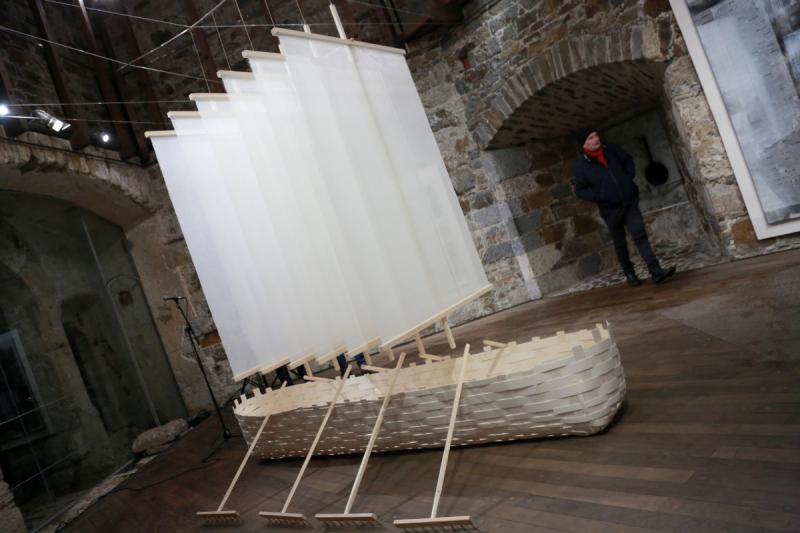
Stjepi alter's ship is an imperfect, improvised, "Apprentice" product in all respects – an almost weightless basket made of poplar veneer, with oars that are rakes, and sails made of permeable, transparent gauze that are separated from the hull. More than an ark, this object is its antithesis – the construction of dysfunction, and with it the decomposition of its established redemptive symbolism and romantic hope of renewal and new beginnings. Stjepi alter's object is not really a ship, but its Mirage and a blind spot in the eye of humanity. At best, it is a "work in progress" with an open end.
This is not just an ambivalent social reflection, but an object of the artist's personal "iconography". Gauze-a material with a pronounced symbolic character – is the author's favorite painting base, and the rake is his frequently used painting tool. The material structure of the object therefore enters into a reciprocal relationship with the paintings on the wall: from their perspective, the sails are established as a pendent of the whiteness of the still unactivated painting surface, and traces of rake teeth in thin Chinese Mulberry wood paper draw a tear of strokes. At the exhibition, the collective symbolic field is intertwined with a personal, intimate creative space. The images are created in a complex network of events that line up through an improvised, partly unconsciously regulated palimpsest processuality. Their palimpsest structure is characterized by intermediate spaces – places of transience, which are formed during the placement and disassembly of the image, during its erasure, as well as the accumulation of layers. In a slightly different way from what the artist wrote, the painting acts as a "time capsule" that allows you to travel through your own temporality and your own history – and at the same time, collective time is inscribed in it on a symbolic level. Similar to the metaphor of the ship, art is a form of epistemological search for meaning, exploration and cognition – a concept "in the making" that is being decomposed and re-established.
Stjepi's creative practice is investigative and at the same time meditative, focused on the search for fluidity between body, mind and creative process. In her highly material experience, however, there is also an "active illusion". This, according to Robert Pfaller, is a fundamental feature of the game, which allows today a particularly rare opportunity for freedom, detachment and departure from the collective rituals of everyday life.
Exhibition curator: Dr. Nadja Gnamus
More about the artist: https://vladostjepic.si
The exhibition was prepared in cooperation with the Association of fine artists Ljubljana:
Vlada Stjepića poznamo kot slikarja z izrazito dihotomično ustvarjalno prakso. V svojem opusu je temeljit in subtilen raziskovalec barve in njene prostorske razsežnosti, ki jo na drugi strani vzporeja s procesualnimi, stihijskimi in palimpsestnimi deli s tušem, ki oblikujejo samosvoje območje med risbo in sliko. Objekti v njegov opus vstopajo dialoško – ne vzpostavljajo zgolj internega, znotrajumetnostnega dialoga z lastno prakso, pač pa le-to postavijo v kontekst širšega družbenega razmisleka.
Tako je mogoče razumeti tudi Stjepićevo instalacijo Noetovi vajenci, ki z naslovom razstavljeni objekt nemudoma postavi v širši simbolni, kulturološko zaznamovan kontekst. Ladja, ki jo umetnik umesti v jedro prostora, ima v različnih kulturah, religijah in mitih arhetipski pomen s ponavljajočimi se vzorci. V zahodni kulturi in umetnosti njena simbolna vloga presega svetopisemsko interpretacijo, povezano z odrešenjem, preizkušnjo in obljubo. Skozi literarne klasike je postala metaforična podoba zadnje možnosti, (moralne) preizkušnje in kraj arhetipskega boja ter vztrajnosti. Takšna vstopa v kolektivni spomin z večnima podobama Ahabove barke iz Moby Dicka in Hemingwayevega trmastega starca, ribiča Santiaga. Nadaljevali bi lahko s podobami iz filmov in vse do sodobne umetnosti. Barka je kulturološki koncept in metafora, ki dandanes lahko ponazarja mikrokozmos človeške skupnosti, utopično kolektivno zatočišče na prostranem in negotovem terenu sodobnega sveta, ki ga pestijo apokaliptični strahovi vojn, okoljske krize, politični in socialni konflikti. V takšnih soočenjih ljudje nismo bolj opremljeni kot vajenci, ki se učijo predvsem iz napak in improviziranih rešitev.
Stjepićeva ladja je v vseh pogledih nepopoln, improviziran, »vajeniški« izdelek – skoraj breztežna košara iz topolovega furnirja, z vesli, ki so grablje, in jadri iz prepustne, transparentne gaze, ki so ločena od trupa. Bolj kot barka je ta objekt njena antiteza – konstrukcija disfunkcije, s tem pa tudi razgradnja njene ustaljene odrešenjske simbolike in romantičnega upa o prenovi in novih začetkih. Stjepićev objekt v resnici ni ladja, ampak njen privid in slepa pega v očesu človeštva. V najboljšem primeru je »delo v nastajanju« z odprtim koncem.
Pri tem ne gre zgolj za ambivalentno družbeno refleksijo, temveč za objekt umetnikove osebne »ikonografije«. Gaza – material z izrazito simbolno zaznamovanostjo – je avtorjeva priljubljena slikarska podlaga, grablje pa njegovo pogosto uporabljeno slikarsko orodje. Materialna struktura objekta zato vstopa v recipročni odnos s slikami na steni: iz njihove perspektive se jadra vzpostavljajo kot pendant beline še neaktivirane slikarske površine, sledovi zobcev grabelj pa v tankem kitajskem papirju iz murvinega lesa zarišejo raztrganino potez. Na razstavi se kolektivno simbolno polje prepleta z osebnim, intimnim ustvarjalnim prostorom. Slike nastajajo v kompleksni mreži dogodkov, ki se vrstijo skozi improvizirano, deloma nezavedno regulirano palimpsestno procesualnost. Za njihovo palimpsestno strukturo so značilni vmesni prostori – mesta prehodnosti, ki nastajajo med postavljanjem in razstavljanjem podobe, med njenim brisanjem ter akumulacijo plasti. Rečeno nekoliko drugače od tistega, kar je zapisal umetnik, slika deluje kot »časovna kapsula«, ki omogoča potovanje skozi lastno časovnost in lastno zgodovino – hkrati pa se vanjo na simbolni ravni vpisuje tudi kolektivni čas. Podobno kot metafora ladje je tudi umetnost oblika epistemološkega iskanja smisla, raziskovanja in spoznavanja – koncept »v nastajanju«, ki se razgrajuje in ponovno vzpostavlja.
Stjepićeva ustvarjalna praksa je preiskujoča in obenem meditativna, usmerjena v iskanje pretočnosti med telesom, umom in ustvarjalnim procesom. V njeni izrazito materialni izkušnji pa je navzoča tudi »aktivna iluzija«. To je po Robertu Pfallerju temeljna značilnost igre, ki dopušča danes še posebej redko priložnost za svobodo, nezavezanost in odmik od kolektivnih ritualov vsakdanjosti.
Kuratorka razstave: dr. Nadja Gnamuš
Več o umetniku: https://vladostjepic.si
Razstavo smo pripravili v sodelovanju z Društvom likovnih umetnikov Ljubljana: